
Non-Fungible Tokens for Development in Indonesia: Trialing Non-Fungible Tokens as a Fundraising Tool
Country: Indonesia
Start of Implementation: 2021
Technology: Distributed ledger technology (non-fungible tokens)
Partners:
· Fauna Conservation NFT—technology service provider
• Indonesian Climate Change Trust Fund—Indonesian government agency partner
• Reef Check Indonesia—Indonesian nongovernment organization partner
In line with Strategic Development Goals
• 13: Climate Action
• 17: Partnerships for the Goals
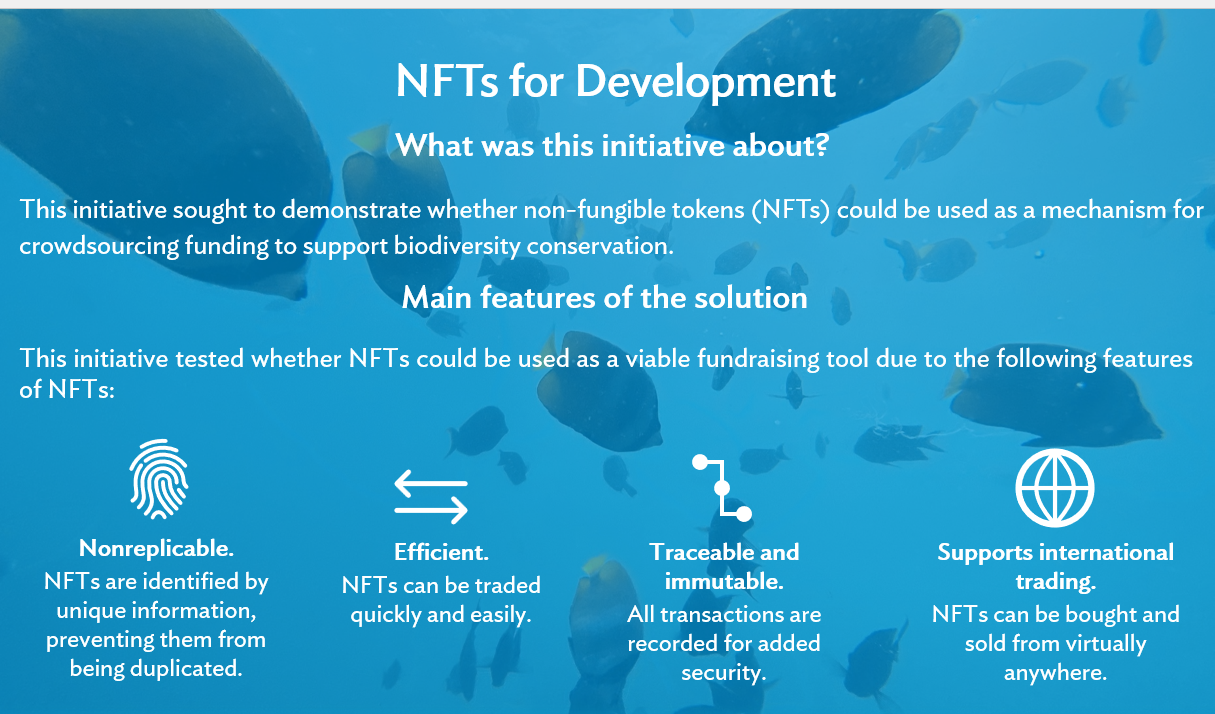
Non-fungible tokens (NFTs) are blockchain-based digital tokens that represent unique assets, including images, videos, and audio files. Each NFT is unique and not interchangeable even if two or more look alike because each one contains information specific to the asset it represents.
The rising interest in NFTs led ADB to open the “NFTs for Development in Asia” challenge in 2021 to explore opportunities in which these could potentially be used to advance ADB’s Strategy 2030 operational priorities. Out of 99 teams that participated in the challenge, Fauna Conservation NFT’s proposal to use NFTs for conservation funding was selected by ADB to proceed with implementation.
Fauna Conservation NFT sought to demonstrate that NFTs could be used as a novel fundraising mechanism to support conservation efforts. The intent was to leverage new technology to engage new donors and complement conventional fundraising approaches.
An NFT is created through a process called minting, wherein key information specific to the asset is encrypted and recorded on a new block in a chain using digital ledger technology. These NFTs are available for purchase on online platforms, thereby allowing an international market to buy and sell NFTs using cryptocurrency. Smart contracts are used for NFT sales, making every purchase traceable and immutable and ensuring secure transactions.48 NFTs also offer efficiency: transactions involving digital assets can be done quickly and easily for users’ convenience.
Fauna Conservation NFT aimed to leverage the indivisible and nonreplicable nature of NFTs that makes them collectible. Their team sought to use gamification to encourage people to buy and sell NFTs in support of a conservation cause.
The Coral Reef Rehabilitation and Management Program—Coral Triangle Initiative Project, which was supported in Indonesia by ADB and the Indonesian Climate Change Trust Fund, was identified as the project where the initiative would be tested. Reef Check Indonesia, a nongovernment organization that was involved in the project, agreed to be the implementation partner. Impact Hub Manila, in coordination with ADB’s Information Technology Department, also searched for experts to mentor Fauna Conservation NFT throughout the process.
Fauna Conservation NFT, with the support of a mentor and in coordination with Reef Check Indonesia, identified the animals that were featured in the NFT collection. Fauna Conservation NFT opted to render the designs in 3D to make them look realistic and stand out from the conventional 2D images of other NFTs. It also engaged an artist from a Cambodia-based design studio to create the artwork for the collection.
The “Non-Fungible Reef” NFT collection featured four unique animal designs: the giant manta ray (Mobula birostris), peacock mantis shrimp (Odontodactylus scyllarus), raccoon butterflyfish (Chaetodon lunula), and common octopus (Octopus vulgaris). Three designs were launched on 4 December 2022 and the fourth on 26 May 2023. A total of 380 NFTs based on these four designs were created (150 raccoon butterfly fish, 100 giant manta ray, 50 peacock mantis shrimp, 50 common octopus). The collection was launched on OpenSea, the world’s largest online NFT marketplace.
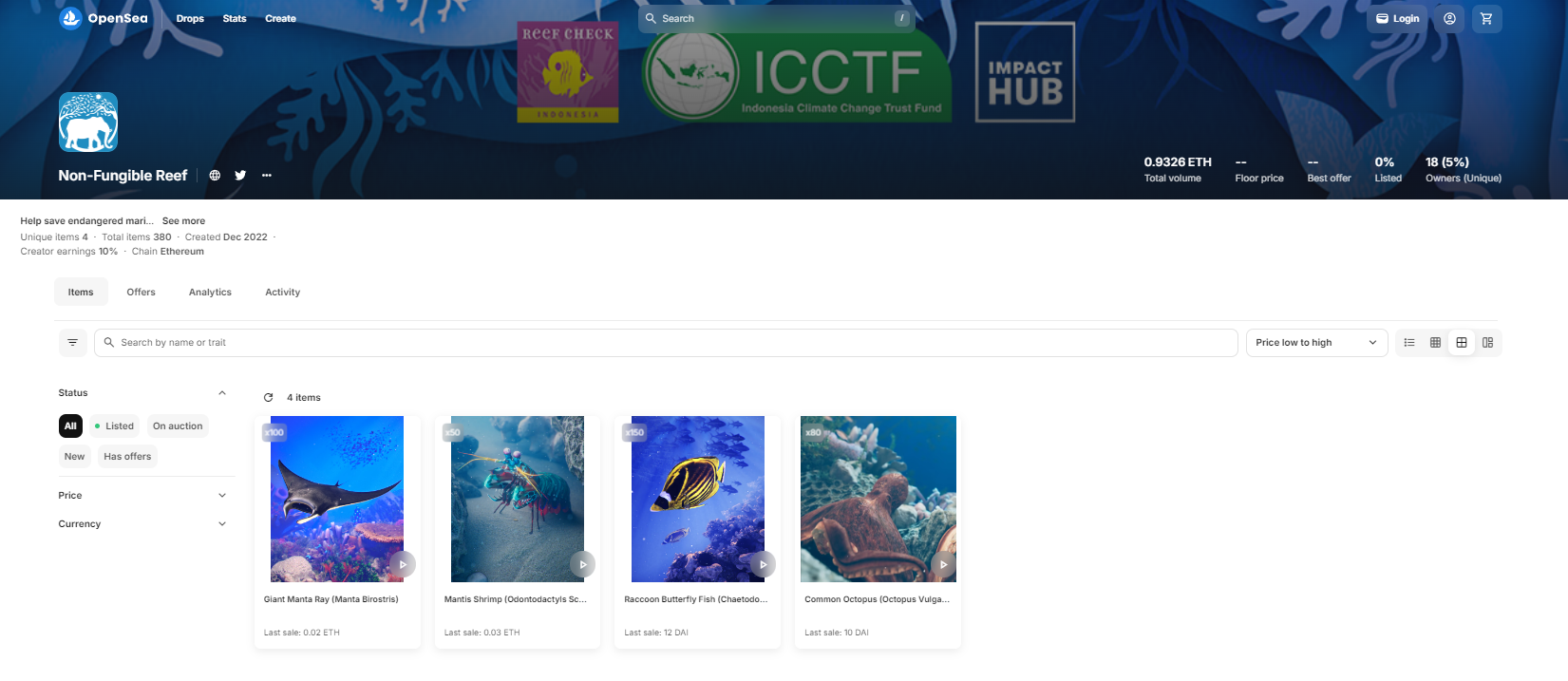
The four NFT designs were sold on OpenSea.
Social media channels were used to promote the sales of the NFTs and to raise conservation awareness.
Some delays were encountered in developing the NFTs, resulting in the collection being released during the cryptocurrency market crash in 2022, which continued until 2023. The NFTs were priced lower than the original plan of Fauna Conservation NFT to try to compensate for this.
The following were the number of NFTs sold per design: 15 of the giant manta ray, 17 of the peacock mantis shrimp, 22 of the raccoon butterflyfish, and 3 of the common octopus. Payments were made in cryptocurrency. Sales reached DAI 366 and ETH 0.7, equivalent to $2,653.16 as of April 2024. Ownershipof the unsold NFTs, along with the sales proceeds, was transferred to Reef Check Indonesia at the end of implementation.