
Developing an Open Application Programming Interface Platform
Year of implementation: 2021– 2022
Technology: Application Programming Interface (API), big data
ADB Partner: Software AG
The Digital Agenda 2030 of the Asian Development Bank (ADB) was conceptualized to support the enhancement of ADB’s operational efficiency and to strengthen its knowledge services. The document identifies the Digital Innovation Sandbox Program as the bank’s avenue to support innovation, promote digital knowledge products and services, and enable digital transformation.
ADB’s Economic Research and Development Impact Department (ERDI), which was then called the Economic Research and Regional Cooperation Department, is ADB’s economic research and data hub. It is responsible for leading the bank in generating new ideas related to economic research and analysis and advising other departments on how to maximize development impact across the institution’s operations. ERDI manages the Key Indicators Database (KIDB), which features a complete set of macroeconomic and socioeconomic statistics, as well as Sustainable Development Goal (SDG) indicators for Asia and the Pacific. This database serves as a key resource for evidence-base policymaking and development planning in the region.
ERDI’s Key Indicators application programming interface (API) was intended to serve as a central hub for sharing data to the public and facilitating data exchanges among ADB, its member countries, and other partners. APIs serve as bridges between different software systems, allowing them to communicate and share data or functionality. With APIs, users can access various programs or components without needing to write or incorporate large amounts of code.
However, the digital infrastructure at the time was limited. Key analytics of the users of the key indicators API were not visible to ERDI personnel, preventing them from getting a better understanding of the knowledge needs of their user base and implement API improvements. In addition, updating the existing API was time-consuming as it required various back-and-forth exchanges between teams from ERDI and the Information Technology Department (ITD).
Thus, the idea came about to create an open collaborative API platform, which would centralize data exchanges between ADB and its partners to enable all relevant parties easy and timely access to information. it was envisioned to include a single dashboard where ERDI personnel could get data related to ADB APIs usage, giving them insights on users’ knowledge needs so they could implement API improvements. It was also intended to serve as a centrally managed platform that hosted all external-facing APIs related to ADB’s key indicators to enable the bank to easily exchange meaningful data easily in a secure manner.
This initiative was anchored on the premise that the private sectors are already using APIs in conducting their businesses, even opening them to the public to crowdsource solutions and develop new products.
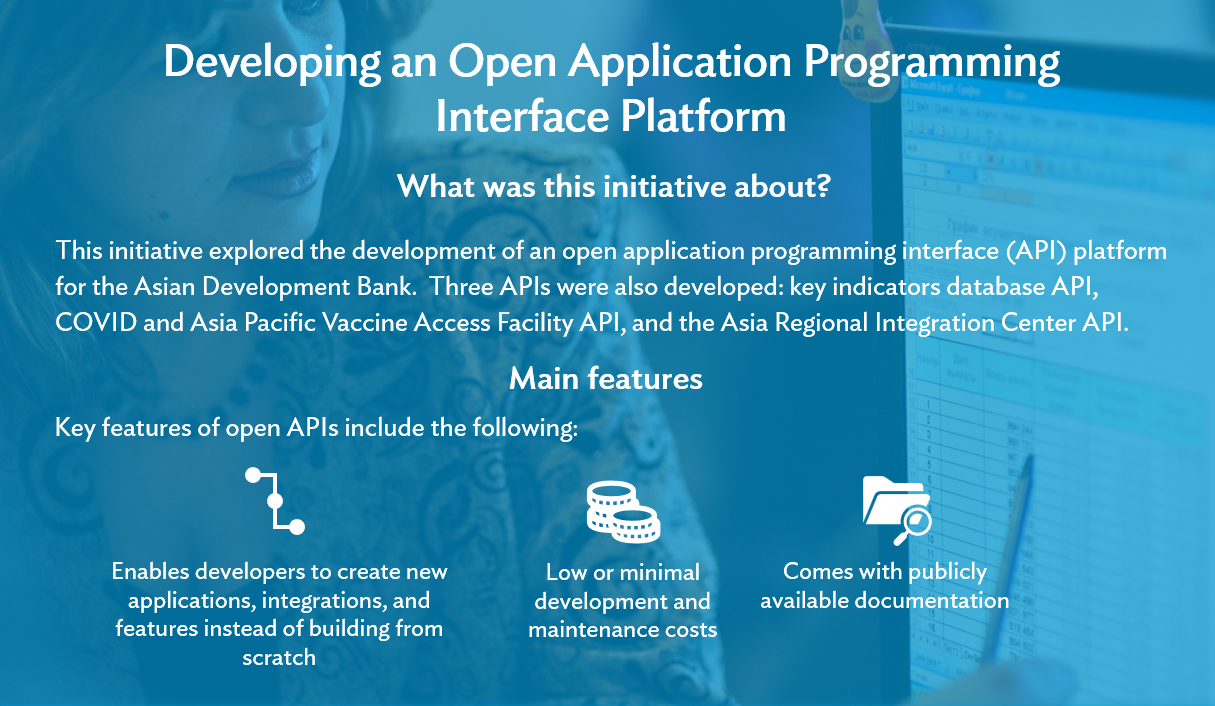
Open APIs, as the name suggests, are publicly available interfaces that allow users to access and interact with a service, platform, or application. They are designed for use by external developers and have no or minimal usage restrictions. Documentation is publicly available as well. With open APIs, third-party developers can create new applications, integrations, and features instead of building them from scratch. That also means lower development and maintenance costs, as well as higher likelihood of app adoption and engagement.
The initiative was brought forward to and approved by the Digital Innovation Sandbox Program’s Project Steering Committee in March 2021. Subsequently, Software AG was engaged to help ADB build the identified APIs. Five personas, with corresponding approaches, were identified: consumer developers, consumer apps, ADB partner community, business admin, ADB developers, and technical admin. After onboarding in mid-2021, Software AG and ADB worked closely to develop and deploy the APIs to be developed. These discussions included the expansion of the scope to develop additional open APIs for external consumption, subject to security requirements.
This initiative leveraged webMethods.io, which is an integration platform as a service (iPaaS) offered by Software AG. This technology was developed to make it easier to integrate applications, databases, and services without requiring extensive coding.
The KIDB API was developed as planned, offering ease in exposing crucial data and statistics for external consumption. The covered data were the KIDB macroeconomic and socioeconomic statistics from 2000 to 2022 for each of ADB’s 49 member countries across Asia and the Pacific.
Two other sets of APIs were developed. ITD and the Procurement, Portfolio, and Financial Management Department (PPFD) collaborated with Software AG to develop the COVID and Asia Pacific Vaccine Access Facility (APVAX) API, which was intended to make it easier for PPFD’s clients to access data related to ADB’s support for COVID-19 vaccination efforts through the APVAX and through regular country allocations. The other API was for the Asia Regional Integration Center (ARIC), which was developed to address security issues and to increase efficiency by streamlining the collection of analytics and addressing concerns related to nonstandard data formats.
All three APIs were designed to support secure and large volumes of data transfers and establish a common data schema standard.
While these APIs were successfully built, only a prototype of the singular dashboard for the APIs was developed. Thus, the bank aimed to scale up this initiative by developing a centralized API portal where business users can try out APIs. There were also discussions on developing and adding more APIs to the planned portal and to support ADB’s operations and knowledge work. Potential future opportunities include developing APIs for other ADB departments to enhance data sharing and organizing hackathons focused on APIs.