
Smart Management and Monitoring of Water Utilities
Country: Philippines
Year of Implementation: 2022–2023
Technology: Internet of things
ITD Partner Department: Climate Change and Sustainable Development Department
Partner:Hiraya Water—technology service provider
Zamboanga City in the Philippines has a high rate of nonrevenue water (NRW), which is water that has been paid for but did not reach customers. In 2022, the Zamboanga City Water District was reported by the Commission on Audit as having the highest NRW among the water districts in Mindanao at 61.6%. The city is also prone to droughts, with the local government frequently declaring the city as under a state of calamity in 2015, 2016, and 2019 due to dry spells. Zamboanga City Water District (ZCWD) has implemented various solutions to address water shortages and reduce NRW, ranging from enforcing water rationing to repair and upgrading of existing infrastructure. Constant monitoring is also critical to reduce NRW and operational expenses. However, the COVID-19 pandemic made monitoring of the various elements of the water network difficult. Continuous and reliable water service is necessary, particularly in the fight against the spread of the virus. Tapping smart water technologies could help water utilities continuously monitor their supply operations remotely and take proactive action.
Hiraya Water was one of the teams selected in the “Improving Remote Monitoring of Water Utilities” challenge in January 2021, besting 34 other teams. Hiraya Water was matched with the Zamboanga City Water District (ZCWD) owing to its allotment of funding for supervisory control and data acquisition (SCADA), which could support smart water management. The water district was contacted by ADB regarding the initiative, and it agreed to participate in the pilot in March 2022.
R-TAP Intelligent Supply and Pressure Management System (or R-TAP) is Hiraya Water’s flagship product. R-TAP leverages artificial intelligence and Internet of Things (IoT) data loggers to determine the optimum settings and conditions of assets within a water network, including identifying issues such as leaks and alerting operators accordingly.
Following the signing of the Memorandum of Agreement between Hiraya Water and ZCWD in December 2022, the two groups threshed out how R-TAP could be tested in Zamboanga City. They determined that what could be covered given the budget and timeline would be to set up data loggers and use R-TAP to recognize and alert ZCWD of anomalies in the water network’s operations. This was intended to support the water district’s plan to transition to a smart water management system.
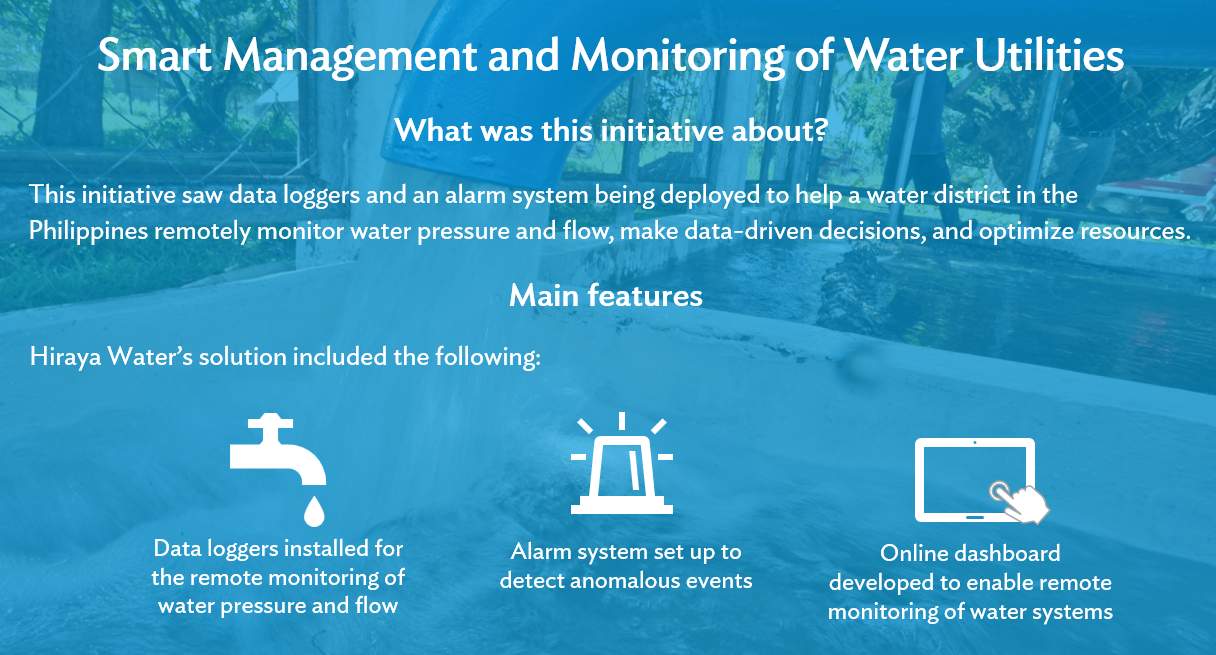
The initial discussion was to install five data loggers to demonstrate R-TAP’s capacity to monitor water pressure and flow. However, some issues led to ZCWD suggesting Hiraya Water to instead use its decommissioned data loggers. Accordingly, ZCWD coordinated with the data logger supplier, which advised that these devices could be re-used as long as their batteries and boards replaced. These actions were taken to restore the data loggers, which were installed in August 2023. ZCWD and Hiraya Water jointly identified which operational line meters in Pueblo District Metered Area (Pueblo DMA), the testing site, to install the data loggers to enable the former to determine the water supply performance even with the limited number of installed devices. It took five days to install seven data loggers.
Additional adjustments were also made on the loggers to resolve issues with the API’s capacity to transmit real-time data. These devices were subsequently integrated to R-TAP’s online dashboard, where Hiraya Water and ZCWD can view heat maps and graphs of the peak and minimum hours of water pressure, as well as flow trends.
An online dashboard was developed for monitoring data transmitted by loggers, including information on water flow and pressure. An alarm system was also set up to enable the system to give alerts when it detected anomalous events such as sudden increase in pressure or sudden decrease in flow. The system gave a prompt when it detected an unusual spike in pressure. Implementation saw an issue with the API, which sent data infrequently and tended to only transmit the last received data.
Through dashboard analysis, ZCWD confirmed that nighttime valve throttling in certain areas produced no measurable impact on pressure or flow. This finding enabled the utility to discontinue throttling, resulting in reduced labor requirements and lower fuel consumption.
Hiraya Water also prepared a smart water management transition plan for ZCWD as part of its committed outputs. The plan was crafted using data from primary and secondary sources, which were analyzed using a combination of quantitative and qualitative methods. ZCWD’s internal records, reports, surveys, interviews, discussions, field visits, and observations served as primary data sources. Meanwhile, the secondary data sources included reports, databases, websites, media articles, case studies, and best practices from other water utilities.
While the full suite of Hiraya Water’s R-TAP, specifically its autonomous artificial-intelligence-powered optimization feature, was not implemented in this pilot due to budgetary constraints, the results demonstrated the clear value of real-time monitoring and AI-powered optimization in improving efficiency and reducing costs. The measurable gains from this limited deployment illustrated the transformative potential of broader, well-funded smart water management initiatives—particularly within the context of ongoing national and regional water sector programs that aim to strengthen resilience, efficiency, and sustainability across utilities.