
Promoting Financial Services with Virtual Reality
Country: Philippines
Year of Implementation: 2023—2024
Technology: Virtual reality
ITD Partner Department: Southeast Asia Department
Partner: XRGlobal—technology service provider
Financial literacy is essential for individual, household, and societal development. Understanding basic financial concepts can help people make informed decisions about debt, savings, and investments. On a broader scale, financial literacy can contribute to achievement of the Sustainable Development Goals (SDGs).
However, financial literacy remains low in the Philippines. According to the 2021 Financial Inclusion Survey, only 2% of surveyed Filipinos who are 15 years old and above correctly answered six basic financial literacy questions, and only 7% attended a financial literacy session. Investing in the financial education of farmers and fisherfolk, who are among the poorest sectors in the Philippines, can unlock their economic potential (Tivera, et al., 2025). Low financial literacy can make them more likely to be burdened by large debts, high transaction fees, and high loan interest rates.
Limited access to financial and digital education is one factor contributing to low literacy levels. At the same time, digital solutions are emerging across Asia and the Pacific to promote inclusive growth, especially for underserved communities. The COVID-19 pandemic accelerated digital transformation but also exposed gaps, particularly in rural areas in the region. In response, ADB has been working to expand the use of digital technologies and data to support rural development, including better access to timely and relevant information.
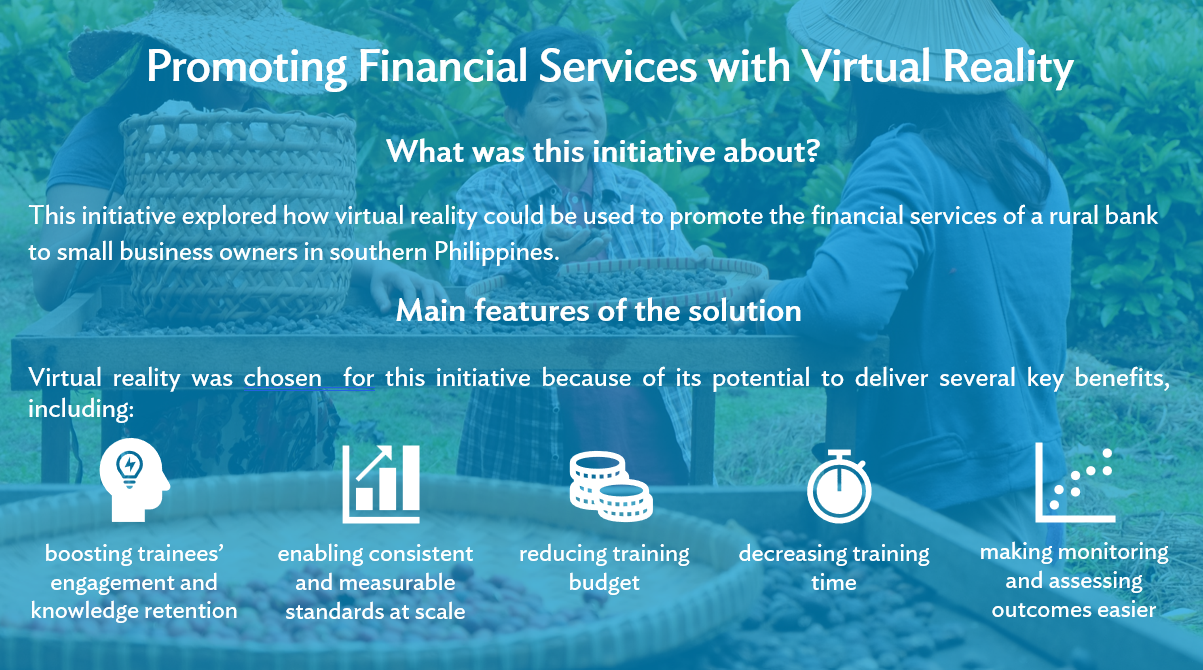
Towards this end, ADB, through the Digital Innovation Sandbox program, explored using innovative technologies, particularly virtual reality (VR), to enhance the delivery of financial education.
A 2020 PWC study found that virtual reality was more effective than traditional classroom and e-learning methods for teaching soft skills. It also showed that trainees could complete the training four times faster than classroom learners and 1.5 times faster than e-learners, even after accounting for the learning curve of getting used to VR headsets. Additionally, VR learners were found to be more emotionally engaged and focused on the content compared to classroom learners and e-learners.
This initiative explored how VR could improve financial literacy in the Philippines. XRGlobal was selected to implement the pilot because of its experience in using VR for agricultural and financial literacy training, and because it applies a gender-sensitive approach to its projects. The company reported that VR training modules could decrease training time by up to 60% on average, based on previous projects.
The team was assigned to develop a fully offline VR experiential learning module and to provide 24/7 remote hardware and software support.
Cantilan Bank Inc. was selected as ADB’s partner for this initiative. The objective was to develop training content that uses VR technology to demonstrate Cantilan Bank’s merchant app and the benefits it offers, with the goal of increasing app adoption by demonstrating its value to small business owners. A storytelling approach was employed to showcase real-life examples of how the app could help entrepreneurs build their digital footprint, enabling access to credit and other financial products.
XRGlobal, Cantilan Bank, and ADB co-created the storyboard for the training module between July and August 2023. Once finalized, field visits to Cantilan, the municipality where the bank originated, were undertaken to film 360-degree footage. Cantilan is located in the Caraga region, where the average family poverty incidence is over 30.8% and only 24% of families have bank deposits.
The VR headsets were configured to collect data on the increase in trainee knowledge after training. Cantilan personnel in the field needed to connect the headsets to the internet post-training for the data to sync to a backend dashboard so it could be viewed and analyzed.
The training modules were finalized in October 2023. Subsequently, a training of trainers session with Cantilan Bank’s key personnel was held in early November 2023. The trainers gave positive feedback and suggested points for improvement, which were incorporated into the module. Updated versions were subsequently pushed out. The module was also rolled out to branch managers in May 2024, although some scheduling delays occurred due to overlapping activities.
Cantilan Bank was provided 16 VR headsets under a lease-to-own arrangement. The VR training was rolled out to existing and potential merchant customers of Cantilan Bank in its branches on Siargao Island and in the Davao and Caraga regions in 2024. The rollout was extended due to additional delays.
Feedback from participants included a request for an English version of the training module, which was originally in Bisaya. In response, English translations and language enhancements based on user input were developed and deployed.
Training data was limited to 25 customers but nonetheless showed promising results. There was an almost 43% increase in knowledge around the benefits and usage of the merchant app.
Among those who were trained, 88% were women. The largest age group was 26–35 years old (39%), followed by the 36-55 age group (35%) and 19 years old or younger (17%). The 56 and older age group had the fewest trainees at 9%.
The training of the bank managers generated positive feedback. All trainees, who were aged 22 to 72, said they would recommend the VR training to merchants. In addition, 91% said that the VR training was very informative, while the remaining 9% said it was informative.
However, the rollout faced challenges due to a shortage of Cantilan Bank personnel, leading to inconsistent outreach to existing and potential customers. Additional delays occurred in deploying VR headsets to various Cantilan Bank branches, further affecting the rollout. Moreover, limited data was uploaded to the dashboard, likely because the headsets were not synced online weekly as planned, resulting in the loss of some training data.
The different parties involved in the initiative aimed to achieve the following targets for clients: make customer payments easier, increase stock management and financial visibility, and improve access to small business loans and other products. While these were achieved, one unanticipated effect was merchants’ hesitation to use the app due to a lack of clear incentives, such as increased income. The bill payment feature could have served as an enticement for merchants to download and use the app, however, its release came after the training was developed and rolled out, and its integration in the module was not covered in the initiative. Since this was not included in the training, staff had to promote both separately, creating competing priorities. When Cantilan Bank realized that the current set of app features were not compelling enough for their target users, they deprioritized the VR rollout and instead focused on rolling out features that would drive usage.
The initiative also faced challenges due to limited personnel dedicated to the VR training, which affected internal buy-in and slowed implementation. The project was based on the assumption that the merchant app’s existing features were compelling enough to drive adoption. This misalignment of expectations impacted the rollout.
Despite hurdles, the VR training received positive feedback from both bank managers and merchant customers. There were recommendations to expand its use across other training programs and activities within Cantilan Bank, highlighting its potential as a valuable tool for financial education, outreach, and training-of-trainers.