
ADB Expertise Locator: Crowdsourcing a collaborative employee platform
Country: Philippines
Year of implementation: 2021–2023
Technology: Artificial intelligence (AI), advanced search and information retrieval, data ingestion and integration
ITD Partner Department: Climate Change and Sustainable Development Department
ADB institutionalized the “One ADB” approach to strengthen collaboration and bring together knowledge and expertise across the organization in support of Strategy 2030. However, fostering collaboration across a workforce of more than 3,000 employees, contractors, and interns—spread across departments, functions, and locations—remained a challenge. A key barrier was the absence of a unified platform where personnel could easily discover colleagues’ expertise, project experience, and professional interests. While People Finder provided basic staff information, it lacked deeper insights into technical skills, areas of specialization, and work history. Other internal personnel systems were fragmented, designed for different purposes, and often relied on voluntary profile creation, limiting participation and reducing visibility into institutional expertise. This fragmentation constrained collaboration, increased the risk of duplicated efforts, and limited opportunities to maximize institutional knowledge and resources.
The COVID-19 pandemic further highlighted the importance of enabling personnel to quickly identify and connect with colleagues possessing relevant expertise, particularly in an increasingly digital and distributed work environment. In response, ADB launched the Expertise Locator Challenge to identify digital solutions that could improve access to staff knowledge, expertise, experience, and interests. The challenge aimed to strengthen internal collaboration by enhancing existing systems or developing an integrated solution that could work seamlessly within ADB’s digital ecosystem.
Using an open innovation approach, the Expertise Locator Challenge crowdsourced ideas from both inside and outside the bank. Launched in mid-2021, the competition invited participation from teams in ADB member countries, as well as ADB personnel. Over a two-month period, teams of up to six members submitted proposals outlining their vision, technical approach, and long-term maintenance strategy, with several teams also developing early prototypes. A total of 39 teams participated. Submissions were evaluated based on business value, operational feasibility and scalability, user experience, technology, and compatibility with existing ADB systems. Four teams were shortlisted for the mentoring phase.
Shortlisted teams then worked with ADB mentors over a two-week period to refine their solutions. Participants submitted revised proposals and pitch decks and joined a masterclass by ADB Ventures on effective storytelling and pitching. The challenge culminated in an online pitch event held on 30 September 2021 as a side event of the ADB Knowledge Forum, where finalist teams demonstrated their solutions before an ADB jury. An internally developed proposal was ultimately selected as the winning Expertise Locator solution.
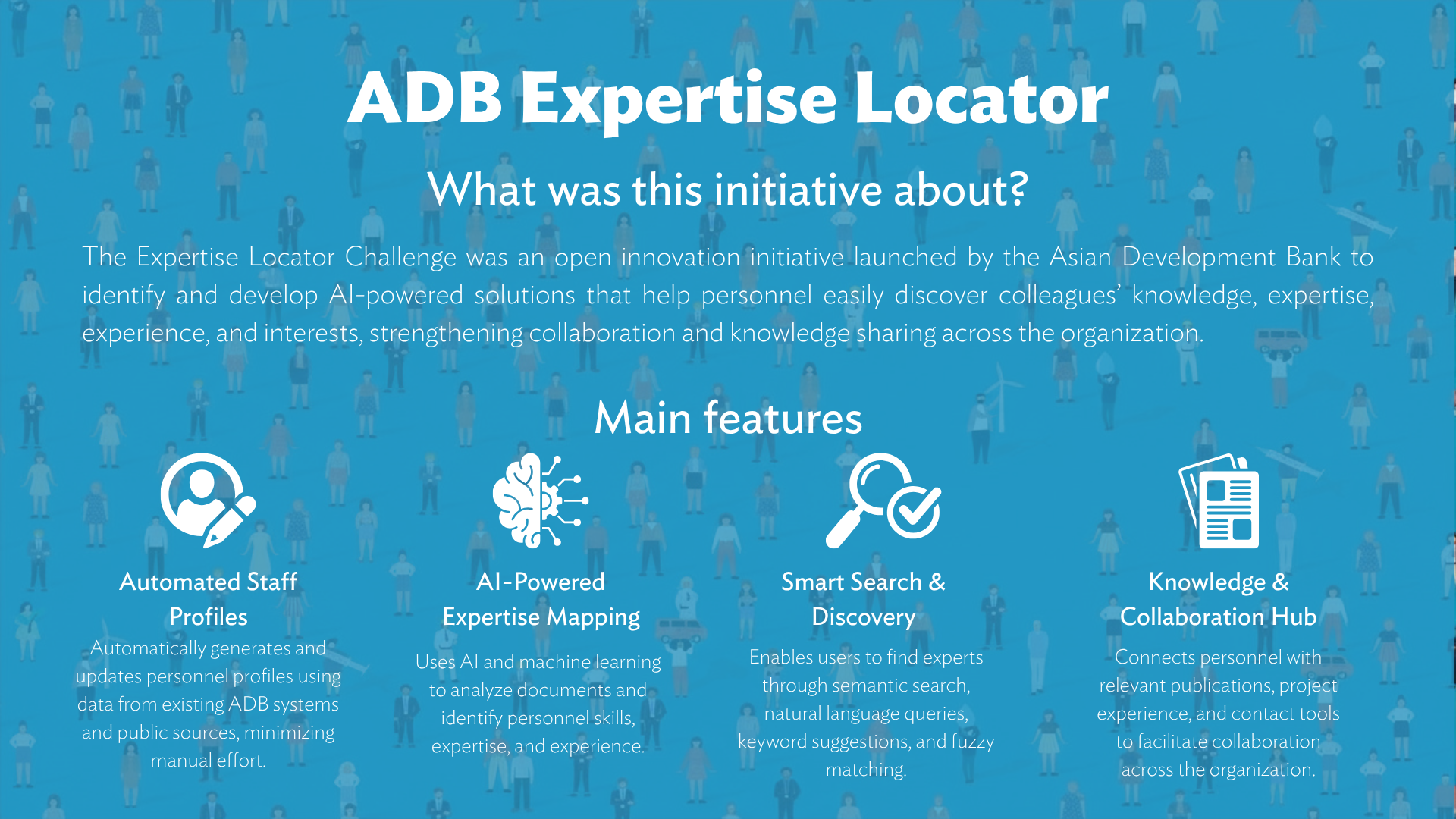
The selected concept was designed to minimize the burden on personnel by automatically generating and updating staff profiles using existing internal systems, including People Finder and MyCareer, alongside publicly available information already hosted on ADB platforms. This information would be continuously indexed to power a user-friendly search interface capable of surfacing expertise across the organization. Early artificial intelligence technologies—including language models and machine learning—were used to process and organize large volumes of data, extract relevant information, and infer skills and subject matter expertise from documents updated on a weekly basis.
To improve discoverability, the solution incorporated advanced search capabilities such as keyword suggestions, approximate matching, synonyms, semantic search, and natural language queries. These features enabled users to identify relevant colleagues even when unfamiliar with exact names, technical terms, or organizational structures.
To test the concept, the team engaged a freelance developer to build a pilot version. Presented in September 2022, the proof of concept drew on more than 7,000 publicly available ADB documents—including working papers, policy briefs, blogs, and project and technical assistance reports. Users could search by name or expertise, with fuzzy search functionality allowing matches despite typographical errors—an improvement over legacy directory systems. Due to privacy and confidentiality considerations, the pilot relied exclusively on publicly available information, as approvals for internal data integration were not secured.
The proof of concept also introduced automatically generated staff profiles based on blog author data, with options for personnel to edit or enhance their information. Publicly available publications authored or co-authored by personnel were linked to profiles, while contact functions and optional integrations such as LinkedIn profile links and searchable keywords helped strengthen visibility and connectivity.
In October 2023, a beta version covering ADB staff, consultants, and contractors was introduced to the broader ADB community. Personnel were encouraged to test the platform, provide feedback, and report technical issues to support continued refinement. The pilot generated valuable lessons, reinforcing that mainstreaming a knowledge discovery platform requires strong internal coordination, governance, and alignment with broader digital transformation efforts. At the same time, it confirmed strong demand for a solution that helps personnel discover expertise and connect people with knowledge across the institution. These lessons have since informed wider digital knowledge management initiatives at ADB.