
Government Accountability and Responsiveness during COVID-19: Digital Solutions to Promote Accountability During a Crisis Situation
Country: Philippines
Year of Implementation: 2021
Technology: Web application, artificial intelligence
ITD Partner Department: Climate Change and Sustainable Development Department
Partner: GoodGovPH—technology service provider
The Philippines, like other countries in the world, was heavily affected by COVID-19. The poorest were severely hit by the pandemic, with many unable to earn because of the lockdowns that were imposed to try to stem the spread of the disease. The Philippine government, through the Department of Social Welfare and Development (DSWD) initiated the Social Amelioration Program (SAP), a ₱205 billion ($4 billion) program that provides cash assistance to 18 million low-income and vulnerable families affected by the pandemic. These included solo parents, the homeless, farmers, fisherfolk, persons with disabilities, and older worth of salaries based on the regional minimum wage. SAP was intended to supplement the Pantawid Pamilyang Pilipino Program, the government’s conditional cash transfer program. However, there were issues that affected the timely distribution of SAP assistance.
The Philippine government also opted to put into place strict measures with corresponding severe punishments if these were broken, which opened opportunities for abuse of power of enforcers. Citizens who had limited resources also struggled with getting legal assistance.
The issues on transparency and accountability were those that GoodGovPH sought to address in its proposal, which was chosen out of 44 team submissions in ADB’s “Government Accountability and Responsiveness during COVID-19” challenge, which the bank ran in collaboration with the Open Government Partnership.
GoodGovPH’s solution stemmed from their free legal assistance and citizen watch programs, which they launched to address concerns about Philippine local government units’ COVID-19 response. The team aimed to enable Filipinos with the means to raise their questions or concerns to government agencies in relation to COVID-19-related concerns, as well as get legal assistance anywhere and anytime. It was also intended to serve as a government accountability mechanism by empowering people to provide feedback to government agencies.
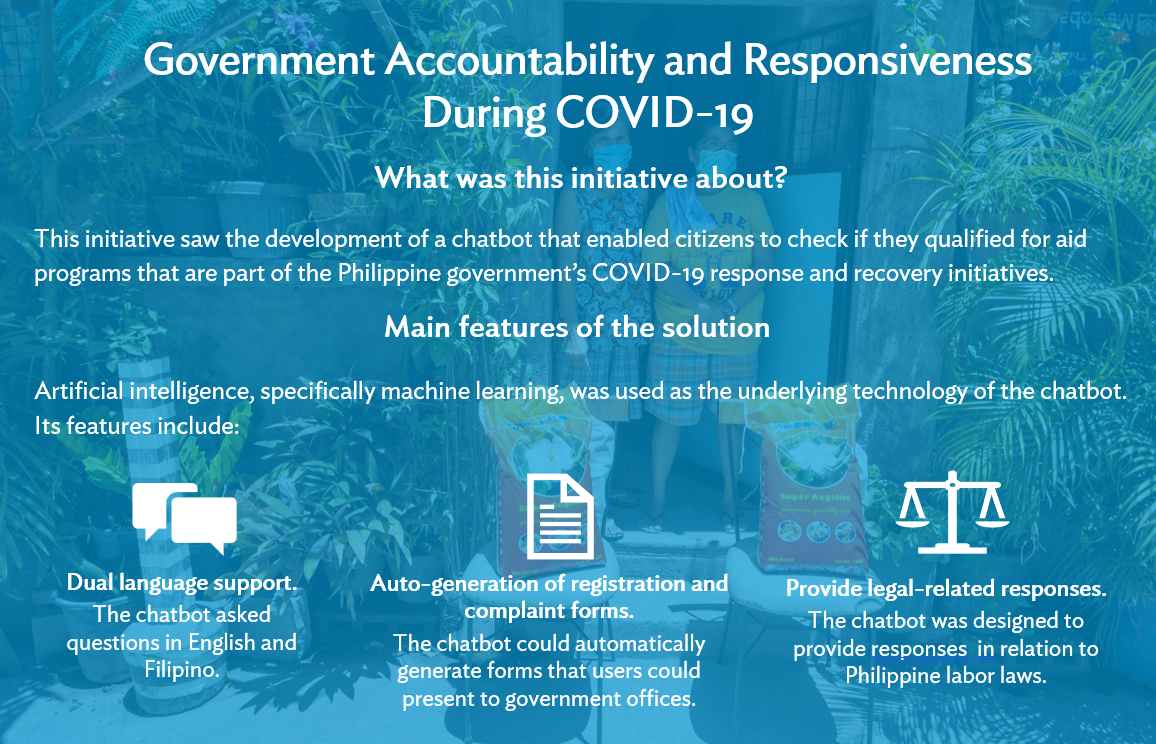
Artificial intelligence, specifically machine learning, was the underlying technology of Bantay, the chatbot that was developed. No-code programming was used as much as possible instead of building the chatbot from the ground up due to cost considerations.
The chatbot was designed to follow a conversation flow to enable it to determine what responses to give to users. If, based on their responses, users were determined to qualify for registration, they are provided a registration form to fill up and submit to the appropriate government agency. The questions were in English and Filipino. The chatbot referred users to human agents in case their queries went beyond the scope of what the chatbot was trained to cover. In addition, the tool had an auto-generated complaint form feature that users could present to government offices. The submitted complaints could also be used by BantayPH to make accountability reports that they could transmit to the relevant government agencies for further action and/or policy development.
The ADB-supported implementation covered two modules: Social Amelioration Program and Senior Pension Program. In addition, the BantayPH team explored how the chatbot can also provide legal-related responses in relation to Philippine labor laws. BantayPH partnered with legal institutions to handle the legal queries.
The chatbot was deployed on Facebook and GoodGovPH’s website. The basic features (e.g., following the conversation flow and being connected to a live agent) were available at no additional cost, while accessing legal forms and making legal consultations were offered as paid services.
The chatbot was beta tested on 28 August 2021 during the General Assembly of GoodGovPH, with the members testing the chatbot’s usability, accessibility, and technological capabilities. It was subsequently presented to the Office of Senior Citizen Affairs (OSCA) and the Senior Citizen Partylist on 8 September 2021. The chatbot was formally launched on 30 October 2021 through an online event.
GoodGovPH rolled out a marketing campaign to promote the app. Originally, the group targeted in the campaign were older persons because they were the beneficiaries of the Social Pension Program. However, GoodGovPH saw that their main users were young and middle-aged adults. As such, they changed their marketing strategy to encourage the users to share the content with older persons. They also joined online platforms mainly used by older persons to reach this audience.
BantayPH aimed to work on multiplatform integration (including SMS and Viber support) to provide users with more channels to get assistance using the Bantay chatbot. The team also sought to support more languages and introduce the chatbot to other parts of the Philippines via the OSCA. In addition, it planned on expanding its content development team to provide a wider array of legal services to stakeholders.